
When we talk about Uttarpara’s history, one family name appears again and again — the Mukherjee family, also known as the Mukhopadhyay family. Their story is not just the story of a zamindar household. It is also the story of how a small riverside settlement on the banks of the Hooghly grew into a town known for education, public service, culture, civic life, and intellectual activity.
From temples and schools to libraries and municipal institutions, the Mukherjees left a deep mark on Uttarpara. Their legacy is still visible today — in the Uttarpara Jaykrishna Public Library, the old Rajbari, the Jora Shiv Mandir, the family Durga Puja, and the many stories that continue to live in local memory.

From Burdwan to Uttarpara
The Mukherjee family originally traced its roots to Burdwan. Sometime in the early eighteenth century, the family migrated to Uttarpara. At that time, this region was part of a much older landscape connected to Saptagram, once one of Bengal’s most important medieval trading centres.
By the mid-eighteenth century, the family had established itself as an important zamindar family along the Hooghly. Like many elite Bengali families of that period, the Mukherjees were not only landholders. They were also connected with education, religion, public life, and philanthropy.
But the family’s importance truly began to grow in the nineteenth century, especially through the work of Jagamohan Mukhopadhyay, Raja Joykrishna Mukherjee, and Raja Peary Mohan Mukherjee.
Jagamohan Mukhopadhyay: The Beginning of a Public Legacy
Jagamohan Mukhopadhyay played an important role in laying the foundation of the family’s public and religious presence in Uttarpara.
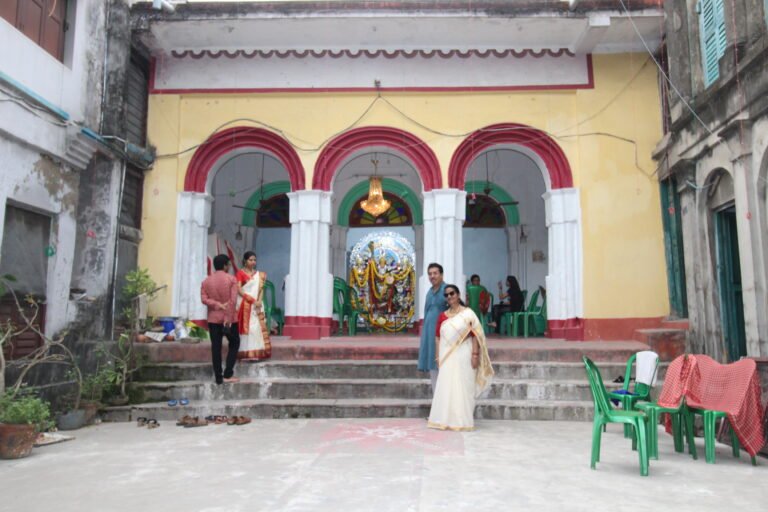
In 1820, he started the Mukherjee family Durga Puja at his own house. More than two hundred years later, this Durga Puja continues to be remembered as one of the oldest and most important family pujas of Uttarpara.
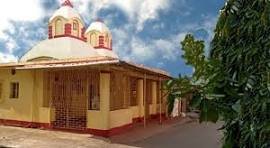
Around the same period, Jagamohan also built the Jora Shiv Mandir on Jaikrishna Street. The temple housed two Shiva lingams, known as Gopaleswar and Shibaniswar. This temple became an important part of the family’s religious life and gradually became connected with the cultural memory of the town itself.
Jagamohan’s will, written in 1840, named his sons Jaikrishna, Rajkrishna, Nabakrishna, and Bijoykrishna as sebaits. It also stated that the puja should continue at the house of the senior-most member of the family. This shows how carefully the family tried to preserve its religious traditions across generations.
Raja Joykrishna Mukherjee: The Architect of Modern Uttarpara
If one person can be called the architect of modern Uttarpara, it is Raja Joykrishna Mukherjee.
Born in 1808, Joykrishna Mukherjee lived through a period of immense change in Bengal. The nineteenth century was a time of colonial administration, social reform, new educational institutions, and the rise of what we now call the Bengal Renaissance. Joykrishna was deeply connected with this changing world.
As a child, he travelled with his father to Meerut and studied in a regimental school. Later, he worked as a record-keeper in the Collector of Land Revenue office in Hooghly. Over time, he became a major landholder and built a reputation that placed him among the prominent zamindars of Bengal.
But Joykrishna Mukherjee is remembered not only for his wealth or landholdings. He is remembered more importantly for what he did with his influence.
The Making of Uttarpara Municipality
One of Joykrishna Mukherjee’s most significant contributions was his role in the creation of Uttarpara Municipality.
In 1851, a cholera epidemic deeply affected the area. Like many towns of that period, Uttarpara struggled with sanitation, clean drinking water, and public health. Joykrishna understood that the town needed a proper civic body to deal with such problems.
His efforts led to the formation of Uttarpara Municipality on 14 April 1853. It is often described as one of the earliest municipal bodies in Bengal. This was a remarkable achievement because it showed a very modern understanding of civic responsibility.
For Joykrishna, public welfare was not just about charity. It was also about building institutions — institutions that could serve people beyond one generation.
Uttarpara Jaykrishna Public Library: A Gift to Knowledge
Joykrishna Mukherjee’s most famous contribution was the Uttarpara Jaykrishna Public Library, opened to the public on 15 April 1859.
This library became one of the great intellectual landmarks of Bengal. At a time when access to books and formal learning was limited, the idea of a free public reading space was visionary. The library attracted scholars, reformers, writers, and public intellectuals.
Many important figures are associated with the library’s history. Michael Madhusudan Dutt, one of Bengal’s greatest poets, spent his last days in Uttarpara. Ishwar Chandra Vidyasagar is also remembered as one of the great personalities connected with the library.
Even today, the Uttarpara Jaykrishna Public Library remains one of the proudest symbols of the town. It reminds us that Uttarpara’s heritage is not only about old buildings. It is also about books, ideas, education, and public culture.
Philanthropy and Public Service
Joykrishna Mukherjee spent a large part of his resources on public works. He supported schools, roads, dispensaries, and civic improvements. By the late nineteenth century, he had spent a very large amount on public benefactions.
Of course, like many zamindars of his time, his legacy must also be understood within the complexities of the zamindari system. While he is remembered for philanthropy, some critics have also pointed out that parts of such expenditure could indirectly affect tenants. This makes his legacy historically rich and layered, rather than one-dimensional.
Even then, what stands out is his strong belief that wealth must be used to create lasting institutions. That is why his name remains so closely tied to Uttarpara’s civic and educational history.
Uttarpara Rajbari: From Family Palace to Public Memory
Joykrishna Mukherjee also built the Uttarpara Rajbari, the family palace. For many years, the Rajbari stood as a symbol of the family’s social position and cultural importance.
Over time, the palace became connected with public welfare. It was later associated with healthcare and public use, and the site became linked to the Uttarpara General Hospital. This transformation itself says something important about the Mukherjee legacy: private family property gradually became part of the town’s public life.
In recent years, there have been concerns about the condition of the old Rajbari. Heritage lovers, local residents, and descendants of the family have expressed the need to preserve it. The intervention of the Bengal Heritage Commission and the possibility of restoration have given hope that this important part of Uttarpara’s history will not disappear.
A museum in the old puja room has also been discussed, where family heirlooms and historical objects may be displayed. If this happens, it could become an important cultural space for residents, students, researchers, and visitors.
Raja Peary Mohan Mukherjee: Scholar, Public Figure, and Nationalist Patron
After Joykrishna, another major figure from the family was Raja Peary Mohan Mukherjee.
Born in 1840, Peary Mohan was known for his education, public life, and association with important institutions. He was among the early distinguished graduates of Calcutta University and is remembered as one of its first Master of Arts degree holders.
He served in important legislative bodies, including the Bengal Legislative Council and the Imperial Legislative Council. But he was not simply a loyal figure within colonial institutions. He is also remembered for speaking against unjust colonial policies, including the Salt Tax.
Peary Mohan was closely connected with education and scientific activity. He was associated with institutions such as the Indian Association for the Cultivation of Science, which later became famous as the place where C.V. Raman carried out his Nobel Prize-winning work. He was also linked with educational and public institutions in Bengal and supported the wider culture of learning.
Uttarpara and the Freedom Movement
The Mukherjee family’s home and institutions were also connected with the nationalist movement.
One of the most famous moments in Uttarpara’s history took place in 1909. After Sri Aurobindo was released from Presidency Jail, he was received by Raja Peary Mohan Mukherjee and Kumar Rajendranath Mukherjee and brought to Uttarpara.
It was in Uttarpara that Sri Aurobindo delivered his famous Uttarpara Speech. This speech became an important moment in the history of Indian nationalism and spiritual-political thought.
The Rajbari and the family’s networks were also associated with several major public figures, including Swami Vivekananda, Bipin Chandra Pal, Bagha Jatin, Rashbehari Bose, Prafulla Chaki, Surya Sen, Dr. Shyama Prasad Mookerjee, and Netaji Subhas Chandra Bose. These connections show that Uttarpara was not a passive town on the margins of history. It was very much part of Bengal’s political and intellectual life.
The Family’s Educational Legacy
Education was one of the strongest pillars of the Mukherjee family’s contribution.
The family played an important role in the establishment and support of educational institutions in Uttarpara, including Uttarpara Government High School. They also supported wider educational initiatives in Bengal.
Raja Peary Mohan Mukherjee served as the lifetime president of institutions such as Bangabasi College and Ripon College, now known as Surendranath College. This shows how the family’s influence went beyond Uttarpara and entered the larger educational world of Bengal.
Their support for education was not accidental. It reflected a broader nineteenth-century Bengali belief that social progress would come through learning, public debate, and institutional reform.
The Durga Puja and Cultural Memory
The Mukherjee family Durga Puja, started in 1820 by Jagamohan Mukhopadhyay, remains one of the oldest continuing traditions associated with the family.
Over time, the puja has changed. Animal sacrifice, which was once part of many old family pujas, was stopped in 1973. Since 2012, the puja has been held at the Jora Shiv Mandir.
This continuity matters. A family puja is not only a religious event. It is also a cultural archive. It carries stories of migration, kinship, ritual, social status, change, and adaptation. Through the Durga Puja, the Mukherjee family’s past continues to remain alive in the present.
Why the Mukherjee Family Still Matters
The story of the Mukherjee family is important because it helps us understand Uttarpara itself.
They were zamindars, but their legacy cannot be reduced only to land and revenue. They helped build institutions. They supported education. They contributed to civic life. They created spaces where people could read, gather, worship, learn, and organise.
Their history also reminds us that towns are not built only through roads and buildings. They are built through ideas, public effort, and long-term commitment.
Uttarpara’s identity as a town of libraries, schools, public institutions, and reformist energy owes a great deal to the Mukherjee family. Their legacy is visible not only in monuments but also in the everyday pride of the town.
When we walk past the old Rajbari, visit the Jaykrishna Public Library, hear about the Uttarpara Speech, or speak of the town’s early municipality, we are also remembering the long shadow of the Mukherjees.
In one line, the Mukherjee family helped turn Uttarpara from a riverside settlement into a town of history, learning, culture, and public life. Their story is not just a family history. It is one of the foundations of Uttarpara’s heritage.
.